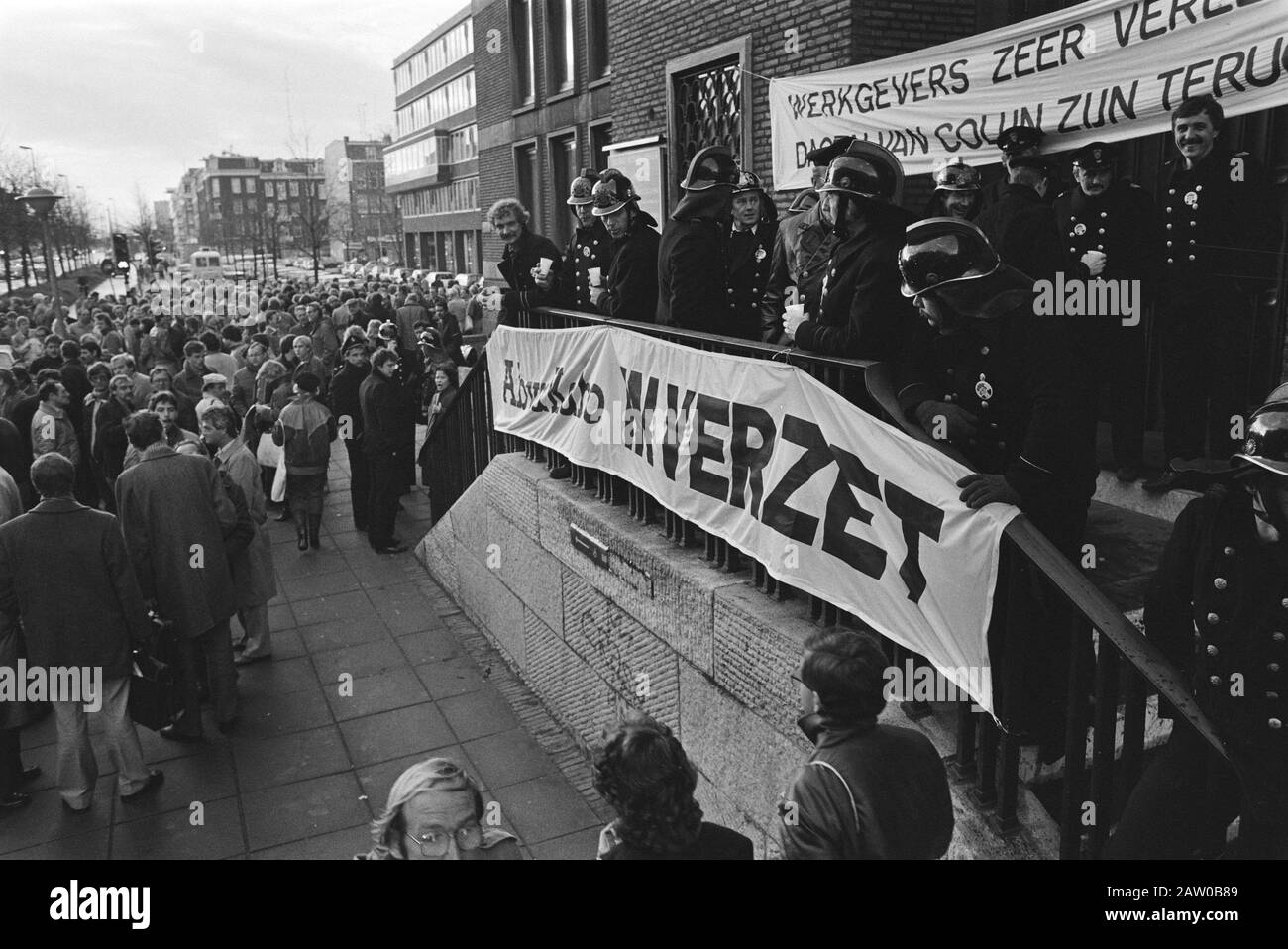
Firefighters Occupy Tax Office on Wibautstraat
This powerful historical photograph captures a significant moment in Amsterdam's labor history: the occupation of the tax office building on Wibautstraat by firefighters on November 21, 1983. The image shows uniformed firefighters standing on a balcony of the building, displaying protest banners to a large crowd of supporters gathered below.
The occupation was part of a larger labor dispute over wages and working conditions. The early 1980s were marked by economic challenges in the Netherlands, with government austerity measures affecting public sector workers. Firefighters, along with other civil servants, were facing wage freezes and potential cuts to their benefits.
One of the visible banners in the photograph reads 'VERZET' (Resistance), highlighting the determined stance of the firefighters against what they perceived as unfair labor policies. Another partially visible banner appears to address employers and their demands.
This protest action at the tax office building is particularly significant in the context of the building's history. The structure, which would later become the Theo Thijssenhuis educational facility, was originally built as a tax office in 1958. By the early 1980s, it had become a symbol of government authority in the area, making it a strategic choice for the firefighters' occupation.
The Wibautstraat area had already developed a reputation as a site for political activism, with the squatters' movement having been active there in previous years (as documented in the 1982 photograph of the De Blaaskop squat eviction). This firefighters' protest added another layer to the building's complex social and political history.
What makes this image particularly striking is the visual contrast between the uniformed firefighters—typically seen as public servants maintaining order—now engaged in an act of civil disobedience. Their professional uniforms and helmets, normally associated with rescue and safety, here become symbols of worker solidarity and resistance.
The large crowd gathered below demonstrates the significant public support for the firefighters' cause. Labor disputes in the Netherlands during this period often garnered broad solidarity across different sectors of society, reflecting widespread concerns about economic policies and workers' rights.
This photograph represents an important chapter in the building's history before its transformation into an educational institution. It reminds us that the spaces we now use for learning and creativity have complex histories, often intertwined with social movements and political struggles that helped shape the city of Amsterdam as we know it today.
Memory Connections
Discover how this memory connects to others
Historical Context
This 1983 photograph captures Amsterdam firefighters occupying the tax office building on Wibautstraat during labor disputes over wages and working conditions, adding another layer to the building's rich history of social activism.
Location
This protest took place at the tax office building on Wibautstraat, the same building that would later be renovated and repurposed as the Theo Thijssenhuis. The photograph shows how the building was a site of social and political action before becoming an educational space.
Time Period
This memory is from November 1983, during a period of labor unrest in the Netherlands when public sector workers, including firefighters, were protesting against wage policies and working conditions.
Themes
Related Memories
Tram and Bus Collision at Wibautstraat
Historical photograph documenting the collision between tram line 3 and an NZH bus at the intersection of Wibautstraat and Ruysstraat in 1963.
Theodorus Johannes Thijssen: The Building's Namesake
The story of the influential Amsterdam writer, teacher and socialist politician after whom the Theo Thijssenhuis was named.
Riotous eviction of squat De Blaaskop
Historical photo showing the empty plinth in front of the Wibauthuis after the eviction of the De Blaaskop squat on January 13, 1982.